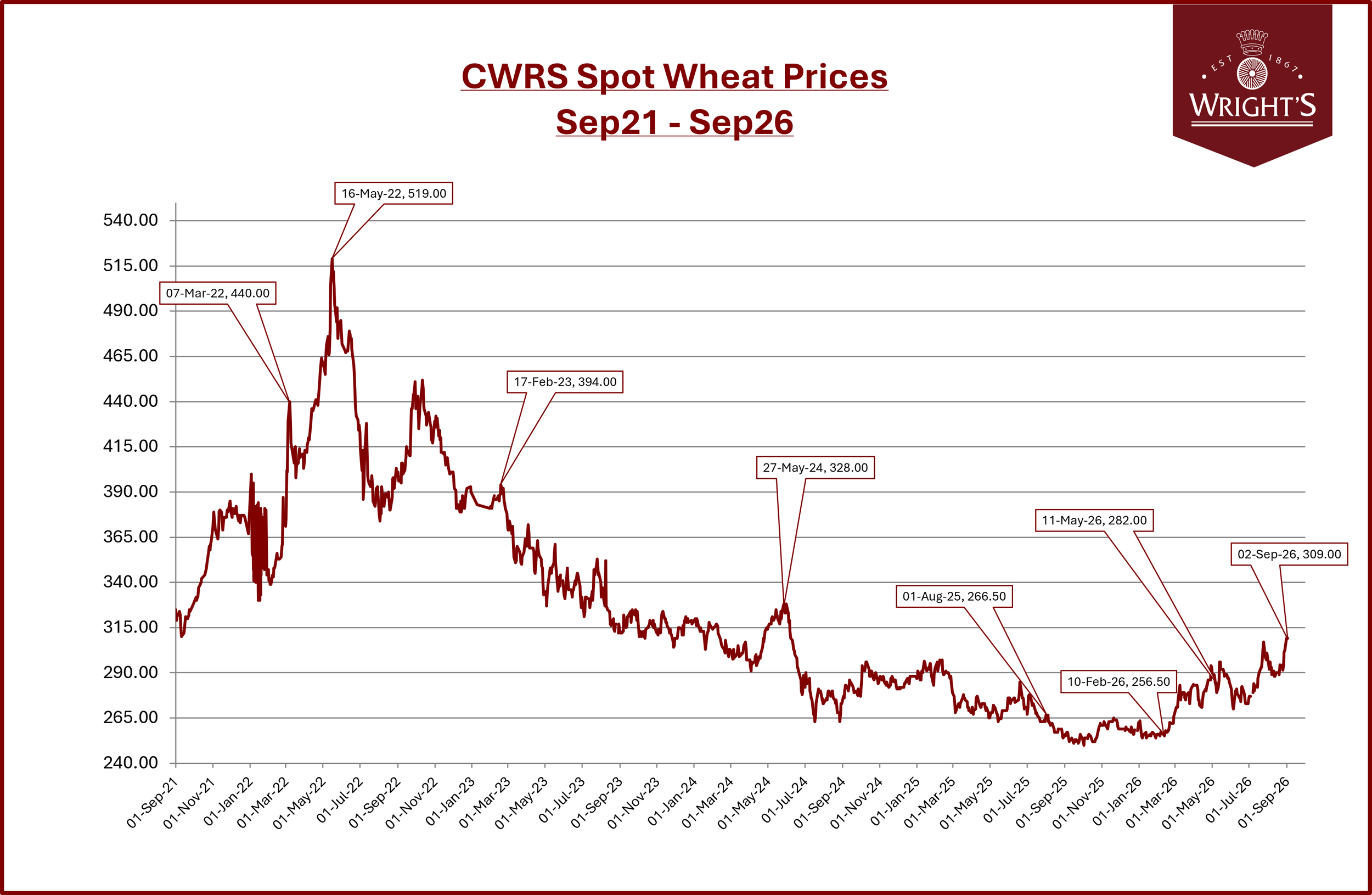

Key closes — as at Wednesday 2 September 2026
| Instrument | Fri 21 Aug | Fri 28 Aug | Today (Wed 2 Sep) | Change (21 Aug → 2 Sep) |
|---|---|---|---|---|
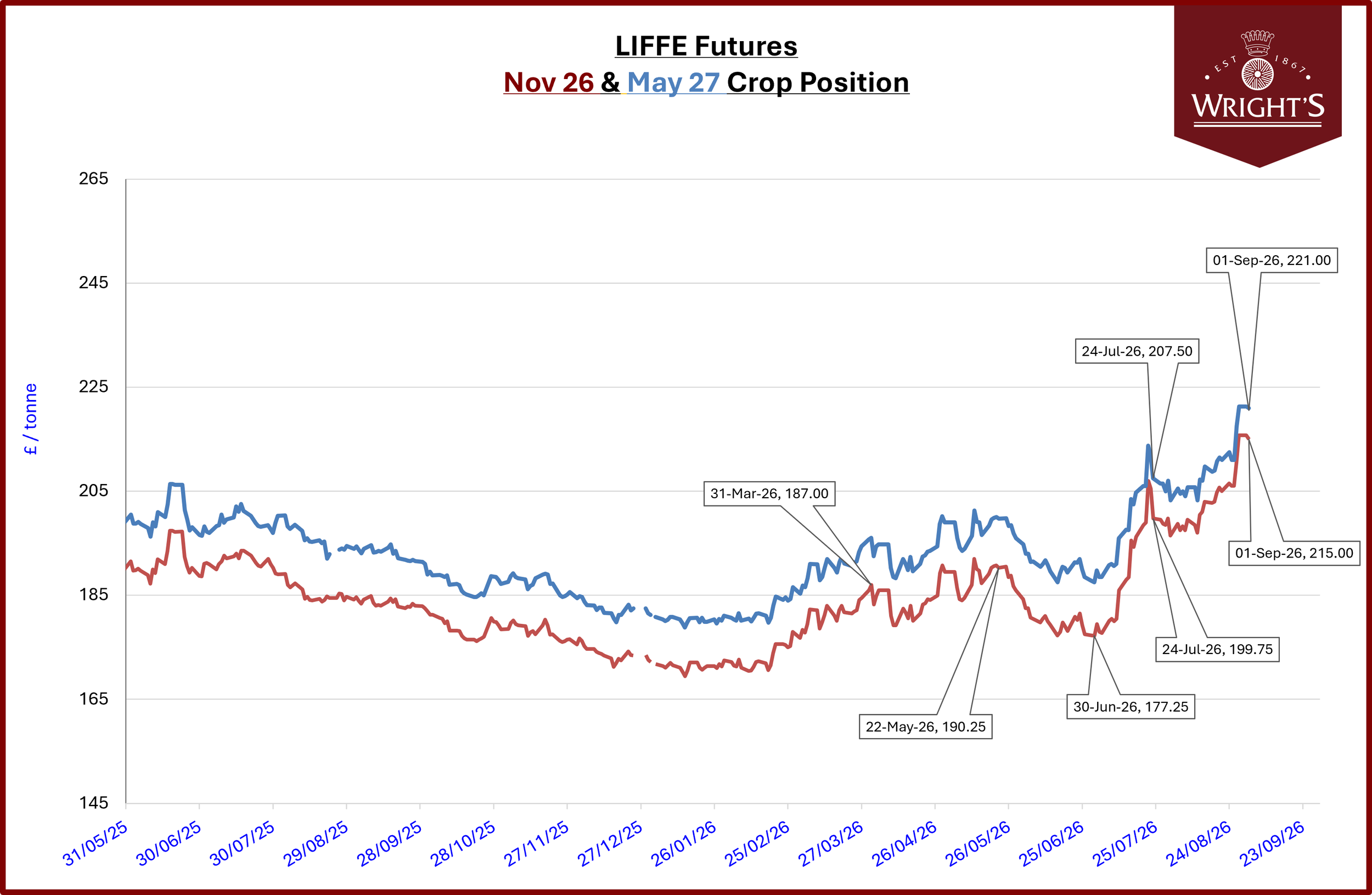
| ICE UK feed wheat — front month (Nov-26) | £205.00/t | £215.75/t | £215.00/t | +£10.00 (+4.9%) |
| ICE UK feed wheat — Nov-26 | £205.00/t | £215.75/t | £215.00/t | +£10.00 (+4.9%) |
| ICE UK feed wheat — May-27 | £212.00/t | £221.25/t | £221.50/t | +£9.50 (+4.5%) |
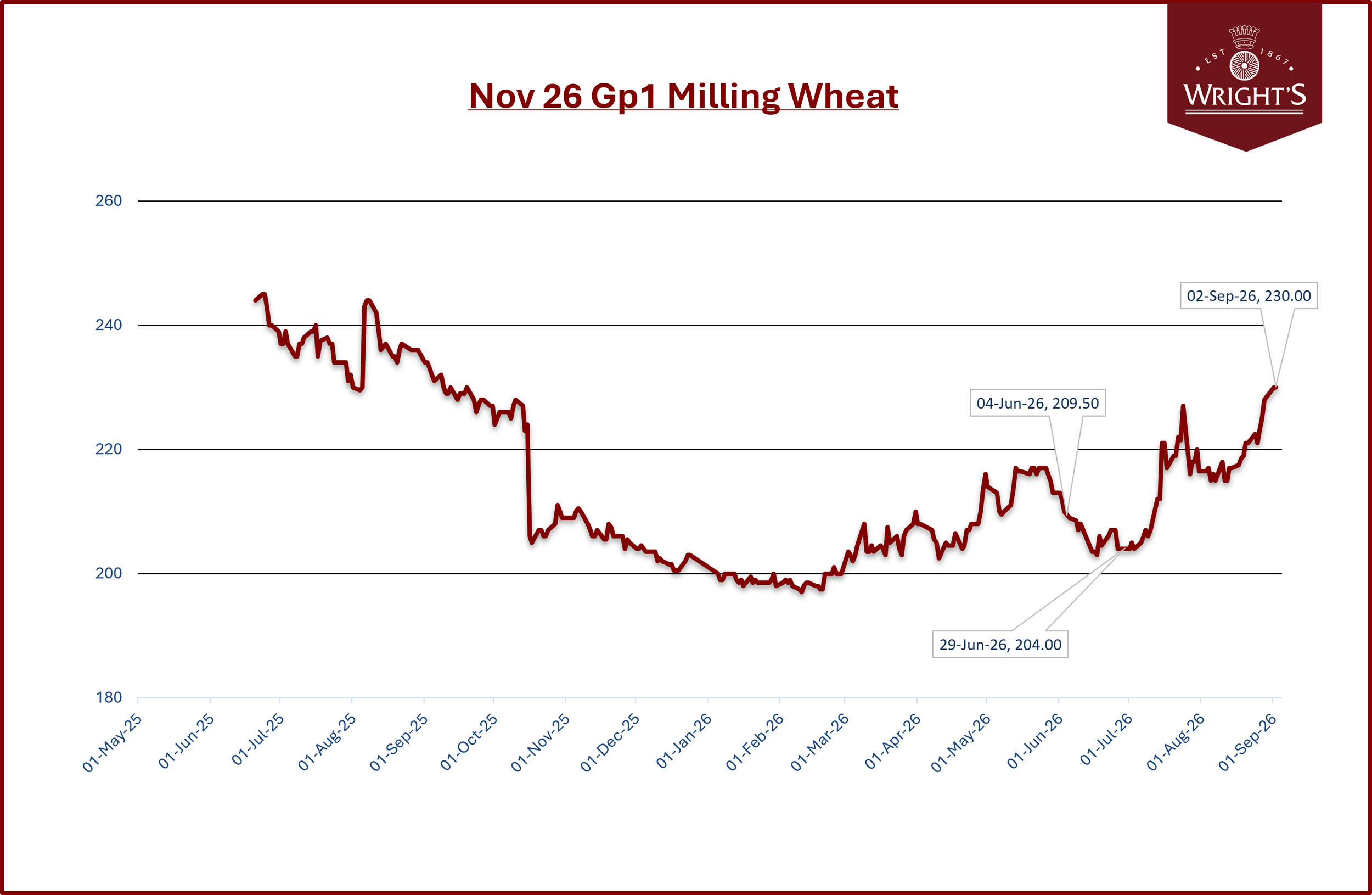
| High protein wheat (Group 1), delivered | £221.00/t | £223.00/t | £230.00/t | +£9.00 (+4.1%) |
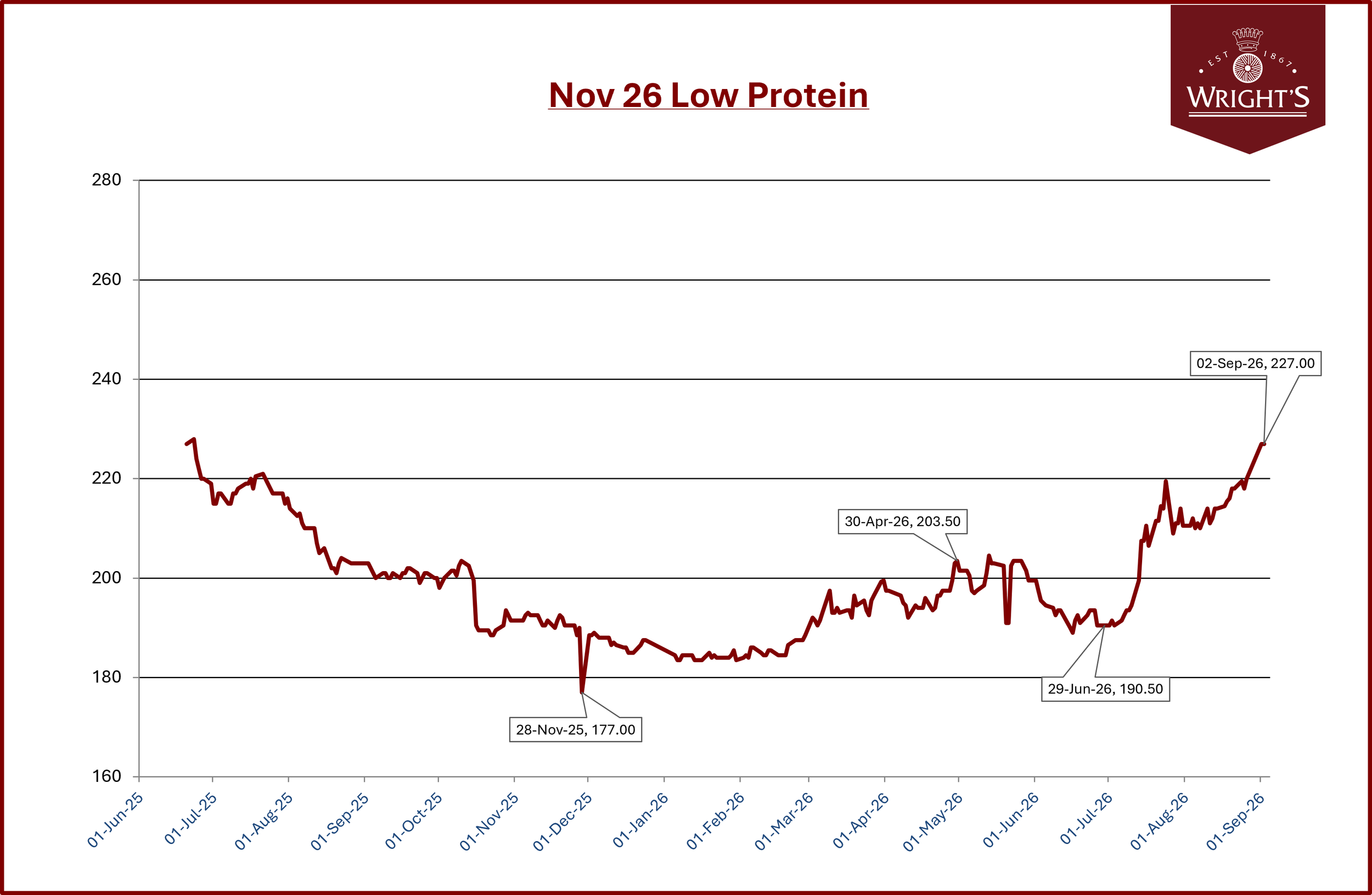
| Low protein wheat (Lows), delivered | £218.00/t | £220.00/t | £227.00/t | +£9.00 (+4.1%) |
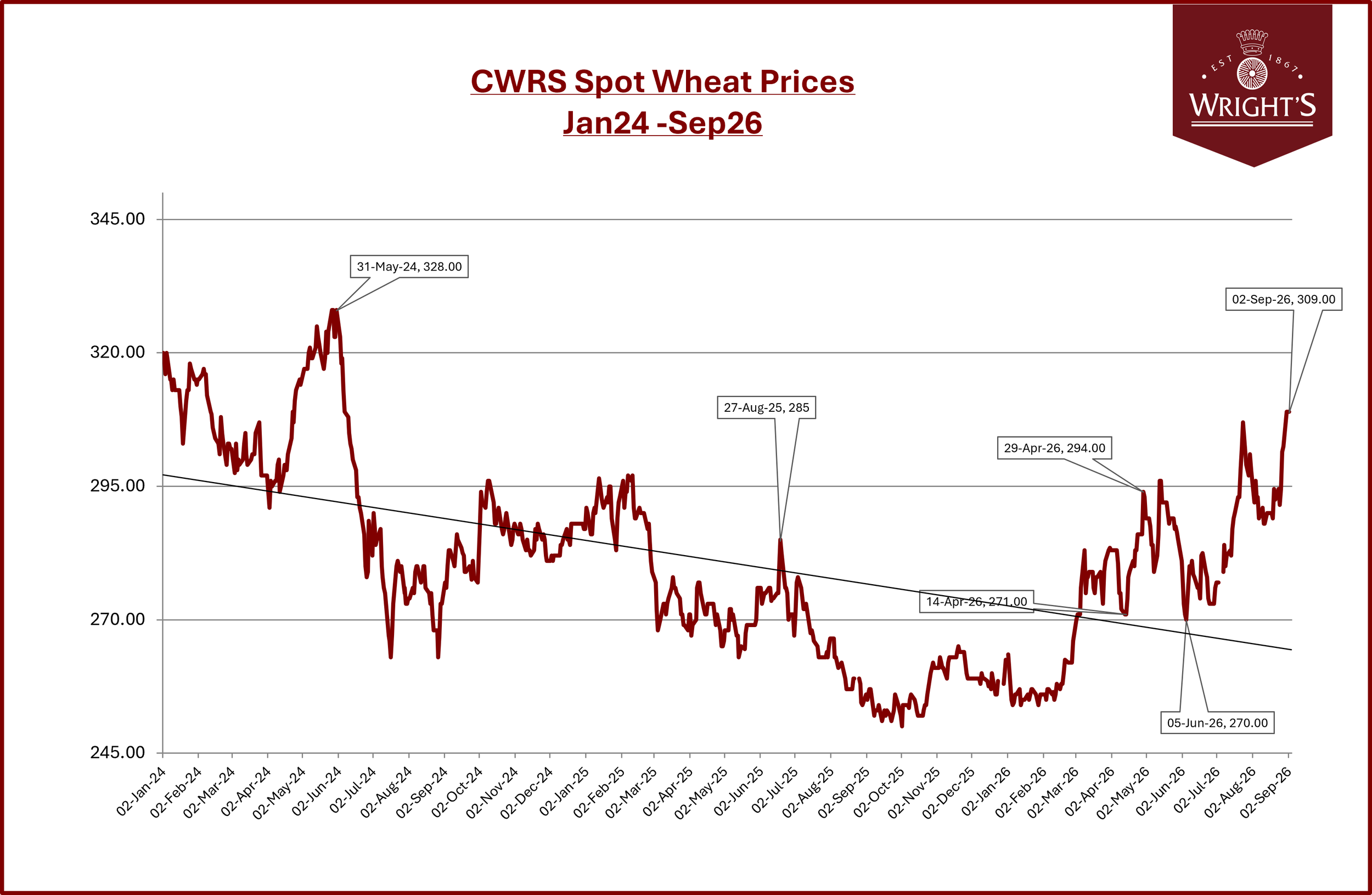
| CWRS 13.5% delivered — spot | £292.50/t | £302.50/t | £309.00/t | +£16.50 (+5.6%) |
| MATIF milling wheat — Dec-26 | €240.00/t | €251.00/t | €250.00/t | +€10.00 (+4.2%) |
| GBP/USD | 1.3661 | 1.3587 | 1.3507 | −0.0154 (−1.1%) |
| GBP/EUR | 1.1671 | 1.1669 | 1.1667 | −0.0004 (flat) |
Market Drivers
Bullish Factors
Exporter stocks decline sharply in 2026/27
Russia-Ukraine shipping squeeze
El Nino threat
Bearish Factors
Comfortable end-2025/26 major exporter wheat stocks
De-escalation in Iran-US hostilities
Strong Middle East/ North Africa harvests shrink import needs
Executive Summary
📉 Sentiment indication: Russia-Ukraine hostilities are slowing their grain exports through the Black Sea to a crawl. Both countries are diverting shipments through other routes, notably overland to Europe for Ukraine, and through the Baltic for Russia, but scope for these alternatives is limited.
Alongside concerns over heat damage to European and US corn, and the renewal of Iran-US hostilities, the Black Sea worries have provided cause to inject risk premium into prices.
Tightening balance sheets, weather threats and geopolitical uncertainty continue to point to higher export prices ahead. However, large carryover stocks and harvest availability should keep rallies in check.
Raw-material cost is roughly £10/t higher on the November contract than in late August, and the near-term risk balance stays skewed upward while Black Sea disruption persists and the UK harvest disappoints on yield. Recent sessions have been volatile; fresh contract highs one day, profit-taking the next , which argues for taking or extending forward cover rather than chasing spikes; a softer pound offers little relief on imports. With a smaller domestic crop, milling-wheat availability and quality remain the watch-points.
UK Focus
ICE UK feed wheat for November 2026 (the front month) settled at £215.75/t on 28 August, up £10.75/t from £205.00/t on 21 August, and is quoted around £215.00/t today (2 September). The May 2027 contract is near £221.50/t, having settled £221.25/t on 28 August. Sterling has softened over the period to about $1.351 and eased to around £1 = €1.167, a marginally weaker pound that gives little relief on import costs. UK feed wheat futures continue to trade around or a little above Paris milling wheat in £/t.
The 2026 harvest is into its latter stages, with the remaining activity concentrated in Scotland, Northern Ireland and northern England, where wetter conditions have slowed progress. Overall yields remain disappointing and highly variable after another dry season; better northern crops have brought only modest improvement to the national picture. Milling quality nonetheless continues to support domestic bread-wheat supply.
Bread-wheat premiums have firmed with futures. On the broker's delivered grid, full-spec Group 1 is £230/t and low-grade "Lows" £227/t at the November position, up from £223/t and £220/t on 26 August, with the Group 1 milling premium steady at about £15/t over futures.
Global Focus
Paris milling wheat (MATIF — the Euronext European wheat futures market) December 2026 pushed to fresh contract highs on Monday 1 September on renewed Black Sea attacks and hostile Russian rhetoric, gaining €6–7/t, before easing to around €250/t today on profit-taking. Chicago wheat (CBOT — the US futures benchmark) and Minneapolis spring wheat had both reached three-year highs in late August (CBOT up about 12% over the week to 28 August) and have since drifted lower with the same profit-taking. Funds are thought to hold a sizeable combined long across the US and EU, so US futures are seen as more supported by fund flows than by physical demand.
The Black Sea remains the market’s engine. Ukraine's August exports are put at just 600 kt, taking the season total to 1.7 Mt against 2.6 Mt a year earlier, and combined Russia–Ukraine exports in the first quarter of the season could run around 7.8 Mt below last year; Russian volumes are also sharply lower. EU cash markets and spreads increasingly reflect demand switching away from lost Russian supply, particularly for 12.5% protein, while low-protein and feed markets remain better supplied.
On weather, US hard red winter areas remain hot and dry with little rain forecast, and southern Europe, the Black Sea and Argentina also stay warm and dry, while northern Europe is wetter. Australia's outlook improved earlier in the period — ABARES lifted its 2026 wheat crop estimate to 29.9 Mt from 26.7 Mt (above the USDA's 28 Mt but below last season's 36 Mt). US weekly export sales remain well below USDA projections, and the International Grains Council has cut its 2026/27 world wheat production forecast to 816.7 Mt on poorer European prospects; early French wheat quality was reported above average.
Imported wheat, delivered (£/t) — September position, as at Wednesday 2 September 2026
| Grade | Mon 24 Aug | Today (Wed 2 Sep) | Change |
|---|---|---|---|
| German A 13% (breadmaking) | £265.50/t | £273.00/t | +£7.50 |
| German E 14% (premium breadmaking) | £289.50/t | £296.50/t | +£7.00 |
| French min 11% | £282.00/t | £288.50/t | +£6.50 |
| CWRS 13.5% (Canadian) | £294.50/t | £309.00/t | +£14.50 |